🧠 Why You Keep Ending up in the Same Place
Listen to article
Your life is the physical representation of all the choices you’ve ever made.
Every outcome, every habit, every relationship, every result—it’s all a reflection of the patterns you’ve been running.
And those patterns? They’re like equations. Not emotional ones, not symbolic ones—just straight math.
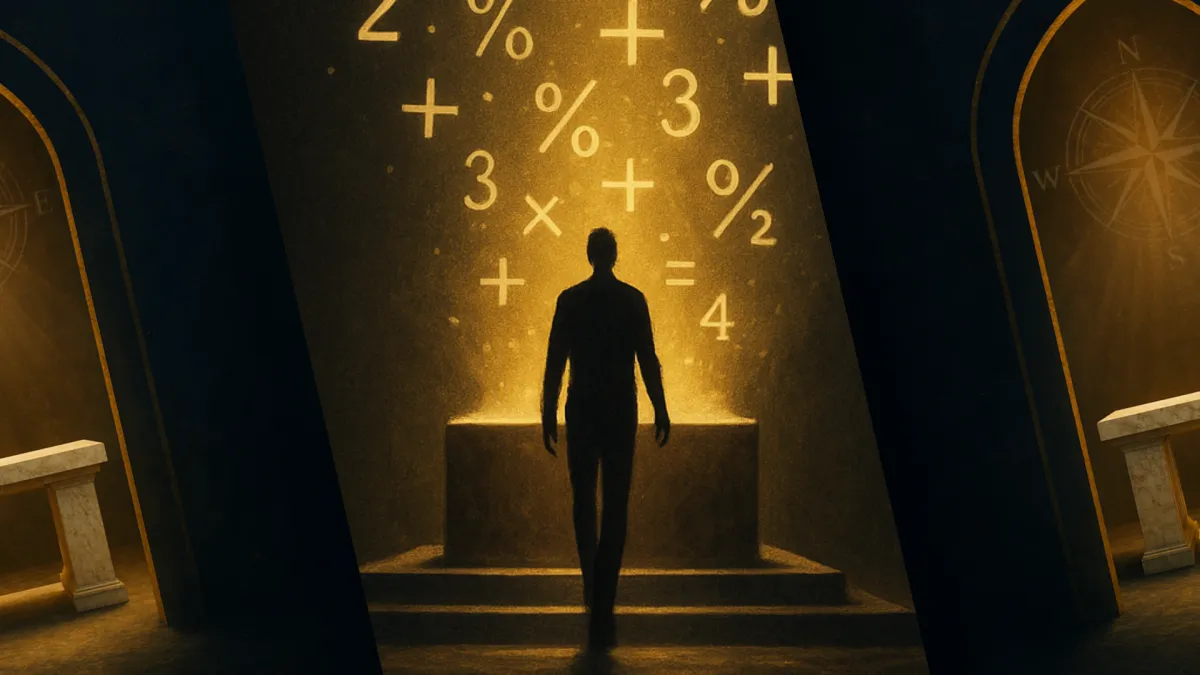
Think about it like this: What do you get when you do 2 + 2? The answer’s obvious. It’s 4.
Now do it again. Still 4.
And one more time, just for good measure—2+2. Still the answer is 4.
It’s so simple it almost feels silly to say. But that’s the point.
The answer doesn’t change if the equation doesn’t change.
It doesn’t matter how hard you try. Doesn’t matter how much you want something different. If your choices stay the same, the outcome does too.
This is what most people miss when they say they’re “trying to change.”
They might swap one variable—start eating better, or try a new routine—but everything else stays the same. Same mindset. Same job. Same patterns. Same triggers. Same stories. Same self-concept.
Instead of 2+2 you start doing 1+3.
It feels different, it looks different, it might even be different, but the answer is still 4.
So if you’re not happy with the answer—if “4” keeps leaving you burned out, stuck, heartbroken, spinning your wheels—why do you keep writing the same equation?
For most of us it’s because it’s the only equation we’ve ever learned.
Sometimes, people do try to change the inputs. They leave the relationship. Switch careers. Move cities. Sign up for the program. Buy the planner. Follow the plan.
But deep down, they’re still chasing the same emotional payoff. The same validation. The same comfort. The same sense of control. They’re solving an equation that looks new but hoping it leads to the same familiar feeling.
And that feeling? That outcome? That’s the one your old self–the constructed identity–was built to survive.
You can’t build a new life while trying to recreate the old emotional payoff.
This is where most people stall. They say they want change—but what they really want is to remain mostly the same and get the new reward. To keep the safety.
To keep the story. To keep the version of themselves that feels like home.
“I’ll change, but only if I still get to feel like I’m in control.”
“I’ll let go, but not of everything.”
“I’ll walk forward, but only if I can still feel like the hero.”
And when you’re trying to change without surrendering your story, you’re not trying to make a change, you’re trying to make a bargain.
You’re saying “I’ll make a change, but only if it still feels like home.”
You’re willing to change enough to feel brave, but not enough to feel lost.
And that’s where The Altar comes in.
It stands in the middle of every meaningful change, not as a punishment—but as a truth-teller.
It doesn’t care how hard you’ve worked. It doesn’t measure how long you’ve struggled. It asks one question: Are you willing to let go of the outcome?
Because you don’t get to design the reward. You only get to surrender to the transformation.
The Altar knows when you’re still trying to control how the story ends. It knows when you’ve dressed the equation up with new numbers but kept the same destination in mind. It knows when you’re still trying to be the one who writes the ending instead of becoming the one who’s ready for something entirely new.
And it won’t let you pass until you drop the script.
This is why real change is so disorienting. It’s not just that you have to act differently—you have to stop trying to feel the same.
You have to release your attachment to the old rewards, the familiar identity, the emotional payoffs that used to feel like safety but deep down you know are just walls.
Because this isn’t about tweaking the formula. It’s about writing a new one.
And that only happens when you stop trying to solve for who you’ve always been and start solving for who you were always meant to become.
-Kasey Hempstead
Author, The Mastery Paradigm™
